 LLM Data Hub
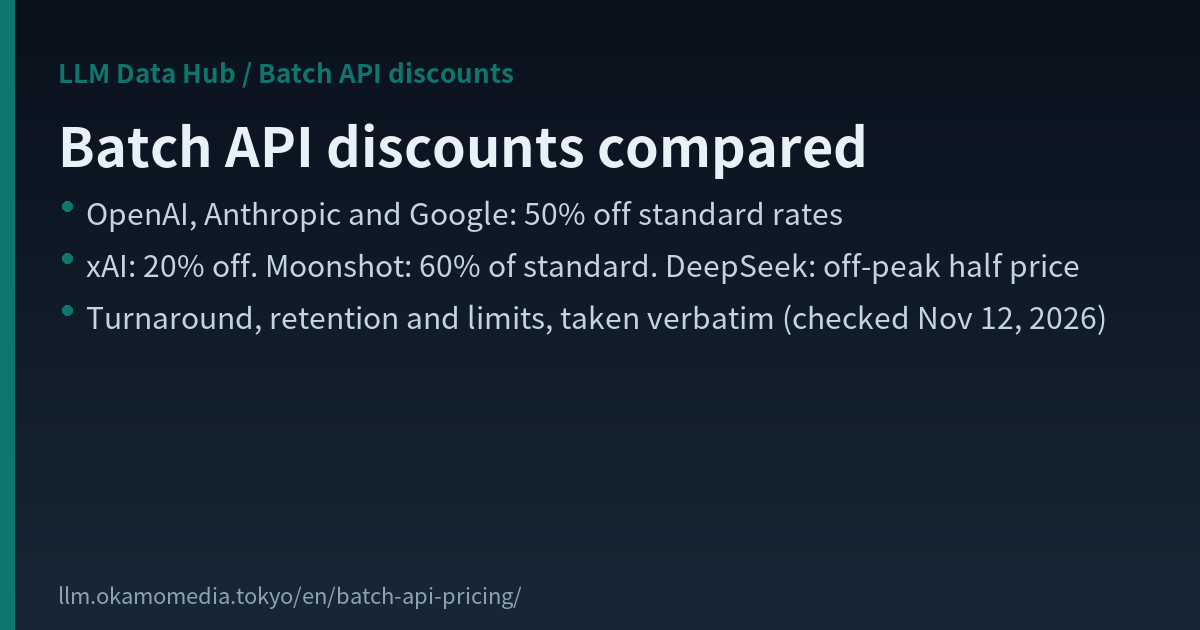
Batch API discounts compared (November 2026)
What a Batch API is: you submit a large volume of requests asynchronously and collect the results later. You give up real-time latency, and the per-token price drops to roughly 50-60% of standard.
How far the per-token price drops when you send a large volume of requests asynchronously, in one table. You trade real-time latency for a lower rate, so "can this job wait?" is the deciding question. Standard rates live in the LLM API pricing comparison; reuse of the same prefix is covered in prompt caching rates compared.
Three things to know first
- The big three all sit at 50% off. OpenAI, Anthropic and Google each halve the standard rate. The discount alone does not separate them, so deadlines, retention and caps do.
- Some providers set the discount per model. xAI varies by model and gives no discount to models outside its table. Moonshot charges 60% of standard, which is shallower than a 50% cut.
- Batch stacks with caching. Anthropic states verbatim: "Batch API and prompt caching discounts can be combined." For a nightly job that reuses the same instructions, cache plus batch is the cheapest combination.
Batch discounts at a glance (USD per 1M tokens)
The first five rows are asynchronous Batch APIs. The last row (DeepSeek) is not a batch API at all; it is a time-of-day discount included for reference.
| Provider | Models | Discount vs standard | Standard (in / out) | Batch (in / out) | Turnaround | Result retention | Caps and limits | Source (fetched) |
|---|---|---|---|---|---|---|---|---|
| OpenAI Batch API | Model-by-model eligibility list not confirmed in what we fetched | 50% off input and output | GPT-6.1 Terra $1.00 in / $5.00 out | $0.50 / $2.50 (calculated) | Within 24 hours (often sooner) | Output file is deleted automatically 30 days after the batch completes | 50,000 requests per batch / 200 MB input file / 2,000 batches per hour | Guide (11-12) |
| Anthropic Message Batches API | Fable 5.2 / Mythos 5.2 / Opus 5.5 / Sonnet 5.5 / Haiku 5.5 / Fable 5.1 and more (table below) | 50% off input and output | Fable 5.2 $8.00 in / $40.00 out | $4.00 / $20.00 (input from the official table, output calculated from 50%) | Not confirmed | Not confirmed | Not confirmed | Pricing docs (11-12) |
| Google Gemini Batch API | Model-by-model list not confirmed. Gemini 4 Carbon: "Batch API isn't supported" | 50% off | Gemini 4 Argon $2.00 in / $10.00 out (through Nov 30) | $1.00 / $5.00 (calculated) | Target turnaround 24 hours (usually much quicker) | Not confirmed | Input file up to 2GB / inline requests under 20MB | Batch API (11-12) |
| xAI Batch API | grok-4.7 / 4.6 / 4.5 / 4.3 / 4.20 family (0309) | 20% off varies by model; unlisted models get no discount | grok-4.7 $2.00 in / $6.00 out | $1.60 / $4.80 (calculated) | Most complete within 24 hours | Not confirmed | Batch requests do not count towards rate limits (request caps not confirmed) | API Pricing (11-12) |
| Moonshot Batch API | kimi-k3.1-pro / kimi-k3 | 60% of standard (40% off) | kimi-k3.1-pro $2.00 in / $10.00 out | $1.20 / $6.00 (calculated) | Not confirmed | Not confirmed | Not confirmed | Kimi pricing (11-12) |
| DeepSeek no batch API found (for reference) | deepseek-flash / deepseek-v4-pro | Off-peak is half of peak (50% off, time-based) | deepseek-flash $0.30 in / $1.20 out (peak) | $0.15 / $0.60 (off-peak) | — (not asynchronous batch) | — | Peak hours 01:00-04:00 and 06:00-10:00 UTC, Monday to Friday | Models & Pricing (11-12) |
"Calculated" means we applied the published discount (50% for OpenAI and Google, 20% for xAI, 60% of standard for Moonshot) to the standard rate. For Anthropic, the input side is quoted from the official batch table and the output side is derived from "50 percent discount on both input and output tokens". Standard rates are those published on 2026-11-12 (Gemini 4 Argon at its introductory price through Nov 30).
Anthropic batch input rates by model (verbatim from the official table)
| Model | Batch input |
|---|---|
| Claude Fable 5.2 | $4 / MTok |
| Claude Mythos 5.2 | $4 / MTok |
| Claude Opus 5.5 | $2 / MTok |
| Claude Sonnet 5.5 | $1 / MTok |
| Claude Haiku 5.5 | $0.05 / MTok up to 100,000 tokens / $0.25 / MTok above |
| Claude Fable 5.1 | $5 / MTok |
| Claude Mythos 5.1 | $5 / MTok |
| Claude Fable 5 | $5 / MTok |
| Claude Opus 5 | $2.50 / MTok |
| Claude Opus 4.8 | $2.50 / MTok |
| Claude Sonnet 5 | $1 / MTok |
| Claude Sonnet 4.6 / 4.5 | $1.50 / MTok |
| Claude Haiku 4.5 | $0.50 / MTok |
When it pays off: a nightly classification job
Say you classify 200,000 support tickets overnight into issue types. At 1,500 input tokens and 200 output tokens per ticket, that is 300M input tokens and 40M output tokens.
| Model | Standard API | Batch | Difference |
|---|---|---|---|
| GPT-6.1 Terra ($1.00 / $5.00) | $300 + $200 = $500 | $250 | -$250 |
| Gemini 4 Argon ($2.00 / $10.00) | $600 + $400 = $1,000 | $500 | -$500 |
| Kimi K3.1 Pro ($2.00 / $10.00) | $600 + $400 = $1,000 | $600 (60% of standard) | -$400 |
The job only needs the results by the next morning, so it fits inside the batch window (mostly 24 hours). A moderation check that has to answer on screen in the same request cannot wait, so it stays on the standard API. In practice: daily aggregation, classification, extraction and embedding jobs are batch candidates, while conversational loops and agents are not.
If every request carries the same prefix (instructions, category definitions), combine this with prompt caching to cut the input side further. Anthropic explicitly allows the combination; OpenAI and Google treat caching and batch as separate discount axes (check each provider's docs for the order of application).
Batch is a latency and deadline trade-off
Batch APIs are asynchronous: you submit a job, get an ID, and collect results later. OpenAI states "Each batch completes within 24 hours (and often more quickly)" and the completion window can only be set to 24h. Google states "The target turnaround time is 24 hours, but in majority of cases, it is much quicker." xAI says batch requests are "queued and processed in the background, with most completing within 24 hours". The docs state an upper bound ("within 24 hours"); they do not say when inside that window a batch will finish. For business-day use, submit the night before and collect in the morning.
Expired requests are handled differently too. OpenAI writes them to an error file (code batch_expired), so you receive the successful subset only, which means designing for partial results and reruns. Rate limits also differ: xAI notes batch requests "don't count towards rate limits". Cheaper, but you own the deadline, partial-failure and collection logic.
What we could not confirm (no guessing)
| Item | Status | Note |
|---|---|---|
| Anthropic turnaround, result retention and request caps | Not confirmed | The pricing docs we fetched contain no verbatim on batch deadlines, retention or caps (we are not claiming they do not exist). |
| OpenAI per-model eligibility | Not confirmed | The batch guide states the discount, window and limits, but we could not capture a model list. |
| Google model list and result retention | Not confirmed | We captured the discount, target turnaround and file limits only. |
| xAI request caps and result retention | Not confirmed | API Pricing confirms the discount and "most completing within 24 hours". |
| Moonshot deadline, retention and caps | Not confirmed | The pricing page states the 60% rate only; batch details live on a separate page to add next time. |
Sources (all fetched 2026-11-12)
- OpenAI Batch API: developers.openai.com/api/docs/guides/batch ("50% cost discount compared to synchronous APIs", "Each batch completes within 24 hours", "The output file will automatically be deleted 30 days after the batch is complete.", "A single batch may include up to 50,000 requests, and a batch input file can be up to 200 MB in size.")
- OpenAI pricing: developers.openai.com/api/docs/pricing (GPT-6.1 Terra $1.00 input / $5.00 output)
- Anthropic pricing: platform.claude.com/docs/en/about-claude/pricing ("The Batch API allows asynchronous processing of large volumes of requests with a 50 percent discount on both input and output tokens.", "Batch API and prompt caching discounts can be combined.", plus the per-model batch table)
- Anthropic Claude Fable 5.2: anthropic.com/claude-fable-and-mythos-5-2 (standard $8 / $40, fast mode $16 / $80)
- Google Gemini Batch API: ai.google.dev/gemini-api/docs/batch-mode ("at 50% of the standard cost", "The target turnaround time is 24 hours, but in majority of cases, it is much quicker.", "The maximum allowed file size for an input file is 2GB.")
- Google pricing: ai.google.dev/gemini-api/docs/pricing (Gemini 4 Carbon row and "Batch API isn't supported"; Argon $2.00 / $10.00)
- xAI API pricing: docs.x.ai/developers/pricing (per-model batch discount of 20% for grok-4.7 to 4.20; applies to all token types; image and video billed at standard rates)
- Moonshot (Kimi): platform.kimi.ai/docs/pricing/chat ("kimi-k3.1-pro and kimi-k3 support batch inference ... billed at 60% of the standard price.")
- DeepSeek: api-docs.deepseek.com/quick_start/pricing ("Off-peak rates are half of the peak rates. Peak hours are 01:00 - 04:00 and 06:00 - 10:00 UTC, Monday through Friday")
Related pages
- LLM API pricing comparison — standard rates by model, with verification dates
- Prompt caching rates compared — read and write rates when you reuse a prefix
- Glossary: prompt caching — how it works and what to watch for
- Token cost calculator — estimate from your input and output volumes
- GPT-6.1 Terra / Kimi K3.1 Pro / Claude Fable 5.1