
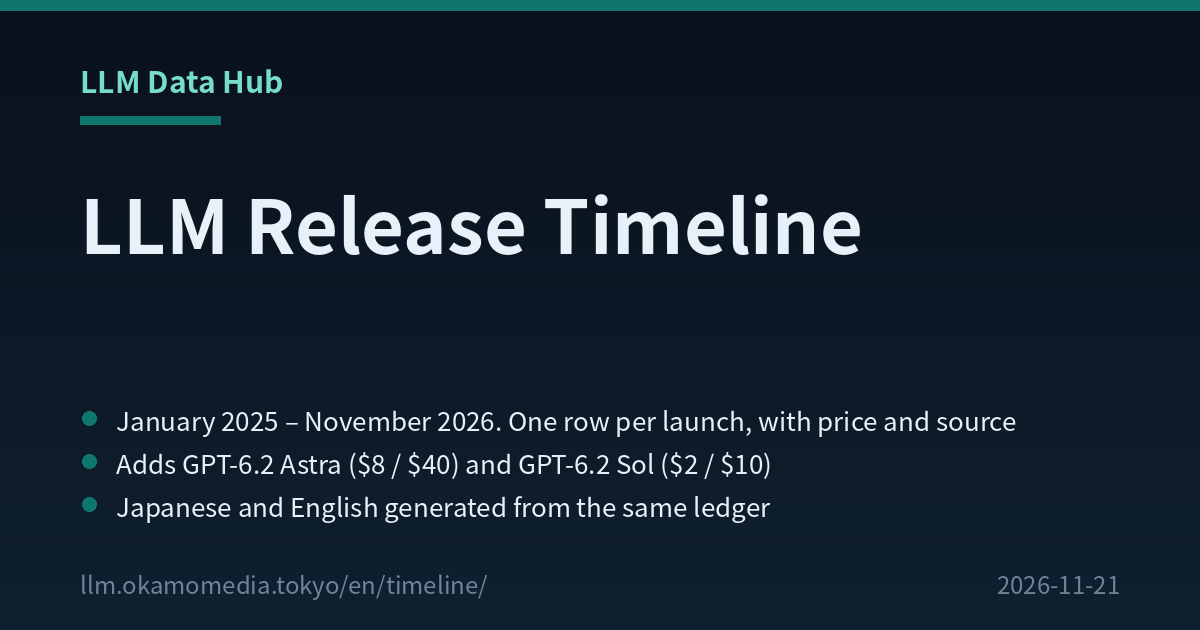
LLM release timeline 2025-2026 with dated milestones for GPT, Claude, Gemini and DeepSeek

Major LLM Model Release Timeline [Jan 2025 – Nov 2026]

Release timeline of major OpenAI (GPT-5), Anthropic (Claude 4/5), Google (Gemini 3), DeepSeek (R1/V4) and xAI (Grok) models, verified against each company's official announcements. See Pricing Comparison for current rates and the Token Calculator for cost estimates.

●Last updated: | Added Gemini 4 Neon (GA 18 Nov 2026, $3.00 / $15.00) and GPT-6.2 Astra for Law (17 Nov 2026, $8.00 / $40.00). GPT-6.2 Astra / Sol announced 17 Nov 2026 | Primary-source links per entry
OpenAIAnthropicGoogleDeepSeekZhipu/Z.aixAIMeta
2026
2026-11-18 Google

Gemini 4 Neon now generally available (GA) — $3.00 / $15.00 flat across the full 1M tokens

The official Gemini API release notes (November 18, 2026) state, verbatim: “Gemini 4 Neon (gemini-4-neon) generally available (GA)” and “$3.00 per 1M input tokens and $15.00 per 1M output tokens”. It supports four thinking levels (low, medium, default high, xhigh), a unified 1M-token context window and long decode up to 1M tokens. The pricing page lists $3.00 input / $15.00 output (including thinking tokens) and $0.15 context caching, implicit caching only (explicit caching is not supported), with no free tier. No tiered pricing above 200K tokens is listed.$3.00 / $15.00

2026-11-17 OpenAI

GPT-6.2 Astra and Sol released — Astra $8/$40, Sol $2/$10

OpenAI's new flagship GPT-6.2 Astra and the general-purpose GPT-6.2 Sol. Astra is 20% cheaper on input and output than GPT-6 Astra ($8.00 in / $40.00 out / $0.40 cached per 1M tokens; long context $16/$60), and Sol keeps GPT-6.1 Sol pricing ($2.00 / $10.00 / $0.10 cached; long context $4/$15). Model IDs are gpt-6.2-astra and gpt-6.2-sol. Available in ChatGPT Work, Codex and the API.

2026-11-17 OpenAI

GPT-6.2 Astra for Law released — legal configuration tops Harvey LAB-AA at $8.00 / $40.00

The official OpenAI post (November 17, 2026) states, verbatim: “Today, we're releasing an updated Astra for Law” and “Every ChatGPT Enterprise customer can now request access through the Trusted Access Program, including through the API”. Astra for Law is a model configuration that pairs GPT-6.2 Astra with an expanded legal search index and instructions; the pricing table files it under “legal configuration”. Pricing is $8.00 input / $0.40 cached input / $40.00 output per 1M tokens, with cache writes at $10.00 (30m) and $20.00 (12h); the promotional rates run through at least December 31, 2026. On Harvey LAB-AA it ranks first with full credit on 20.8% of assignments (GPT-6.2 Astra 15.0%, Muse Wonder Full 13.1%) and averages 0.03 material hallucinations per assignment, the lowest in the comparison.$8.00 / $40.00

2026-11-15 Alibaba / Qwen

Qwen4-Max goes live at $1.50 / $4.50 per 1M tokens with 1M context

Alibaba's next-generation flagship Qwen4-Max is available on QwenCloud (Alibaba Cloud Model Studio). Official pricing is $1.50 input / $4.50 output / $0.075 implicit cache per 1M tokens, with explicit cache writes at $1.875 (5 min TTL) and $3.00 (1 hour TTL). It has a 1M-token context (up to 991K input; 131K output, 262K when thinking) and takes text, image and video input. The Token Plan-only preview (qwen4-max-preview, from 11-11) moved to general availability with published unit prices. Benchmarks and weight availability are unconfirmed.$1.50 / $4.50

2026-11-12 Google

Gemini 4 Hydrogen announced — flat $1.50 / $7.50 across the full 1M tokens

Google positions it as the “daily driver for agentic workflows”. The official blog states “$1.50 per million input tokens and $7.50 per million output tokens” with a flat rate across the entire one-million-token context (no tiered pricing). Context is 1M tokens and output can reach 1M tokens. It is available in Google AI Studio, the Gemini API, Gemini for business, the Gemini app, Google Search, Antigravity, Android Studio and Google Sheets, “rolling out globally”. We read the release stage as a staged rollout with no GA label. The pricing page lists the model at $1.50 input / $7.50 output / $0.075 context caching (implicit caching only; explicit caching is not supported). No batch pricing is listed.$1.50 / $7.50

2026-11-10 Google

Gemini 4 Carbon goes generally available — model row added to the official pricing page

As of 2026-11-03 Carbon was invitation-only (cyber defenders and the Fairwind programme) and had no model row on the official pricing page. The official blog now says “Today, we're making Gemini 4 Carbon available to developers, enterprises, scientists, and consumers.”, so any paying developer or business can use it through Google AI Studio and the Gemini for business API. Introductory pricing is $2.00 input / $10.00 output through 2026-11-30, then $4.00 / $20.00 from December 1. Carbon does not support the Batch API (“Batch API isn't supported” on the official pricing page).$2.00 / $10.00 (to 11/30)

2026-11-09 Meta

Muse Ember released — Meta's smallest and most efficient model at $0.10 / $0.50

A small model that follows Muse Wonder (hardest problems) and Muse Spark (coding and agents), positioned for “the work an agent repeats all day”: tool calls, coding subtasks, routing, extraction and long-document parsing. The official blog says “available today on the Meta Model API, at $0.10 per million input tokens and $0.50 per million output tokens”. It ships as muse-ember-1.0 in Muse Code and the Meta Model API, and is also available through Google Cloud and Oracle Cloud.$0.10 / $0.50

2026-11-09 Anthropic

Claude Fable 5.2 / Mythos 5.2 released — 20% cheaper than the previous generation at $8 / $40

Coding, reasoning and vision improved over Fable 5.1 / Mythos 5.1, with output generation up to 30% faster. The official blog states “available at a lower price: $8 per million input tokens and $40 per million output tokens” — 20% below the previous $10 / $50 on both input and output. Fast mode is $16 / $80. Fable 5.2 is available to all users (“available today on all platforms, including Amazon Web Services, Google Cloud, and Microsoft Azure”); Mythos 5.2 is offered through the cyber and life-sciences validation programme. Batch input is $4 / MTok (50% of standard).$8 / $40

2026-11-05 OpenAI

GPT-6 Cyber released — cyber specialist scores 48.5% on ExploitGym at $20.00 / $100.00 (approved Daybreak Red customers)

OpenAI's cyber-specialized model. The System Card says, verbatim: “cyber-specialized variant of GPT-6 Astra designed for authorized security work, including tasks such as vulnerability discovery, exploit development, and web pentesting”. It uses specialized training to stay within authorized scope, scores 48.5% on ExploitGym (GPT-5.6 Cyber: 32.1%), and avoided out-of-scope services in 99.93% of tests without its deployment prompt (100% with it). Pricing is $20.00 input / $100.00 output per 1M tokens, $2.00 cached input, with cache writes at $25.00 (30m) / $50.00 (12h). Access is gated: verbatim, “initially available through the API and Codex to a select group of approved Daybreak Red customers” and “We will progressively expand access to all Daybreak Red customers soon”.
Note: a separate line from GPT-6 Sol / Terra; its Preparedness Framework designations match GPT-6 Astra (Critical in Cybersecurity).$20.00 / $100.00 · limited access

2026-10-28 Google

Gemini 4 Carbon announced — cyber-defense focus, limited access for now

Availability: limited access, not GA. Verbatim: "Starting this week, we will make Carbon available to a subset of cyber defenders and will gradually phase access to additional trusted partners through our Fairwind Program." Access for developers, businesses and consumers is "as soon as possible" i.e. not available yet; Google says it is taking part in the U.S. government's voluntary pre-release testing process.
Price: not listed. Google's official pricing page (ai.google.dev/gemini-api/docs/pricing) has no Gemini 4 Carbon row; as of Nov 3, 2026 the only Gemini 4 row there is Gemini 4 Argon. The blog announces a launch price: "will launch at the same introductory price as Argon at $2 per million input tokens and $10 per million output tokens, with cached input tokens priced at 95% off input token price", with a footnote adding $4.00 input / $20.00 output after the introductory period. We do not treat these as shipping prices.
Benchmarks: #1 at 59 on Artificial Analysis Intelligence Index v5.0 (Artificial Analysis's own index). SEC-bench Pro 88.2% (sec-bench), ExploitGym 54.8% (sunblaze-ucb/exploitgym) and CWE-bench 71.0% (Collinear) are third-party benchmarks, and Google notes they were "evaluated without guardrails". WebDev Arena: #4 at 1768 (+89 elo). Claims such as "more than 2x uplift" in secure code generation versus Argon and the Chrome team's "more than 10X better" patch quality are Google-internal or partner claims.
Not disclosed: API model name, context window, output limit, knowledge cutoff and tiered pricing are absent from the post, so we do not state them.Price not listed (announced $2.00/$10.00)

2026-10-26 OpenAI

GPT-6.1 Terra launched — a fast, low-cost computer-use model

The step up from GPT-5.6 Terra ("A significant step up from GPT-5.6 Terra" in OpenAI's own words). Standard API pricing is $1.00 input / $0.05 cached input / $5.00 output per 1M tokens, which the launch post describes as 50% lower than GPT-5.6 Terra and GPT-6.1 Sol. 1,050,000-token context, 128,000 max output; above 272,000 input tokens the whole request is repriced at 2x input and 1.5x output. Available in ChatGPT Work and Codex (Plus/Pro/Enterprise/Edu) and via API as gpt-6.1-terra.
Note: the launch post gives no explicit date ("Starting today"); third-party coverage agrees on 2026-10-26. $1.00/$5.00 (cached $0.05)

2026-10-23 Moonshot

Kimi K3.1 Pro series rolls out — 3T-class, 1M context

First model in the new K3.1 series. In Kimi's own words, "our most capable 3T-class model to date", with a 1M-token context and stronger coding, 3D creation, financial research and long-horizon agent work. K3.1 Pro Highspeed ships alongside it at roughly 2-3x the speed with the same quality (K3.1 Pro on Plus/Moderato and above; Pro/Allegretto and above unlock up to 1M context; Highspeed on Pro/Allegretto and above). Thinking mode only: low/high/max, default high. (2026-11-07 update: the official pricing page now has a kimi-k3.1-pro row: $2.00 input, $10.00 output, $0.20 cached input, 1,048,576 context, Batch at 60%.)$2.00/$10.00 (cached $0.20)

2026-10-13 Google

Gemini 4 Argon is generally available — a 1M-context flagship reasoning model

Pricing: $2.00 input / $10.00 output (including thinking tokens) / $0.10 context caching per 1M tokens. All are introductory rates through November 30, 2026, rising to $4.00 / $20.00 / $0.20 on December 1. Implicit caching only (explicit caching is not supported) and no free tier (“Not available”).
Specs: 1,048,576-token context window (a unified input and output limit), 65,536 max output synchronously and up to 1,048,576 with long decode. Model ID gemini-4-argon, status Stable (GA); the official model page states “Latest update: October 2026”.
Positioning: built for complex software engineering, hard maths and science, autonomous multi-step agents and long decode.$2.00 / $10.00 (through 11/30, cache $0.10)

2026-10-12 Meta

Meta launches Muse Wonder / Muse Wonder Full — its agent-first frontier models

Pricing: muse-wonder-1.0 is $4.00 input / $0.20 cached input / $20.00 output per 1M tokens. No long-context premium (rate is flat whether the window is nearly empty or nearly full) and no Contributor mode. Web search grounding is billed separately at $2.50 per 1,000 queries.
Specs: 1M context, built for long-running agents, sub-agent delegation and advanced computer use (browser, desktop, mobile).
Tier above: Muse Wonder Full is not token-priced; it ships by subscription in Muse Code (Power $50/mo, Maximum $200/mo). Muse Code plans also serve muse-spark-1.3 / 1.2 / 1.1 at $1.25 input / $0.15 cached / $4.25 output (Contributor mode $0.10 / $0.002 / $0.20; Spark 1.1 is Standard mode only).$4.00 / $0.20 / $20.00

2026-10-07 Anthropic

Claude Haiku 5.5 released — fastest and cheapest of the Claude 5.5 family at one tenth of Haiku 4.5

Pricing: $0.10 input / $0.50 output per 1M tokens up to 100,000 tokens — one tenth of Haiku 4.5 ($1.00/$5.00). Above 100,000 tokens the rates become $0.50 / $2.50. Cache reads $0.01 ($0.05 above 100k); cache writes $0.125 for 5 minutes and $0.20 for one hour.
Specs: 1M context, 128K max output (300K on the Batch API with a beta header), adaptive thinking on by default at effort medium, Fastest latency, knowledge cutoff June 2026.
Caveats: the new tokenizer shared with Claude 4.7 and later counts the same text as roughly 30% more tokens than Haiku 4.5, and temperature, top_p or top_k return a 400 error when set to non-default values. $0.10/$0.50 (above 100k: $0.50/$2.50)

2026-10-06 Google

Gemini Nano Banana 2.1 released — updated image generation and conversational editing; Nano Banana 2 (3.1 Flash Image) deprecated

Status: generally available per Google’s official release notes (Oct 6, 2026). An update to Nano Banana 2 (gemini-3.1-flash-image) that keeps Flash-level speed and cost efficiency while improving visual quality, prompt adherence, multi-turn character consistency, text rendering, and wide / panoramic ratios (1:4, 4:1, 1:8, 8:1) at 1K, 2K and 4K.
Pricing: $1.50 input, $7.50 output (text and thinking), $30 per 1M image tokens — roughly $0.0336 at 1K, $0.0504 at 2K and $0.113 at 4K per image (half on Batch). Output resolutions 1K (default) / 2K / 4K; thinking levels minimal / medium (default) / high.
Also announced: gemini-3.1-flash-image (Nano Banana 2) is now deprecated (no shutdown date announced) and Google points users to gemini-nano-banana-2.1.$1.50 / $7.50 ($30/M images · $0.0336 at 1K)

2026-09-30 Google

Gemini 4 Argon announced — rolling out to trusted cyber defenders first, general access phased

A new frontier model.
Release stages: (1) rolling out now through the Fairwind Program — the post's term is "trusted cyber defenders"; a limited program for invited testers such as security specialists, not an open sign-up; (2) to developers, enterprises and consumers "as soon as possible", starting with paid API customers and Google AI Ultra subscribers per the official post. Google says it is engaged in the U.S. government's voluntary pre-release access process while it iterates on guardrails and expands access.
What you can do today: the only route is the Fairwind Program (invitation-based) — no general API or consumer access yet, and you cannot buy at this price yet. Context: 1 million tokens (per the post summary).
Pricing: $2 per 1M input tokens / $10 per 1M output tokens, with cached input at 95% off the input price, is announced as an introductory price for launch; the post does not state that billing has started.
Benchmarks: the official post publishes no benchmark table, so we do not list aggregate-site scores as numbers here (any mention stays at the level of "as reported by ...").Announced intro price $2/$10 (cached input 95% off)
Gemini 4 Argon became generally available in October 2026; see the entry below and the pricing comparison.

2026-09-29 OpenAI

GPT-6.1 Sol released — the balanced GPT-6 model, same price as Sol with cached input halved

Positioning: the official model page says “Near-Astra performance for complex work at a lower cost”. Model ID gpt-6.1-sol.
Pricing: $2 input / $10 output (same as GPT-6 Sol), $0.10 cached input (5% of input), $2.50 cache writes. Prompts above 272,000 input tokens are repriced at 2x input and 1.5x output for the whole request. Fast 2x, Ultrafast 6x, Batch/Flex 50% off.
Specs: 1,050,000 context, 128,000 max output, 922,000 max input, knowledge cutoff 2026-04-30. Reasoning effort low / medium (default) / high / xhigh / max; none and minimal are not supported (GPT-6 Sol supports none).
On the date: the model page states no release date, so we publish the date reported by third parties and label it as third-party information. $2/$10 ($0.10 cached input, $2.50 writes)

2026-09-28 Anthropic

Claude Sonnet 5.5 released — the balanced model of the Claude 5.5 family, at the same price as Sonnet 5

The second model in Anthropic's Claude 5.5 family; the docs call it "the best combination of speed and intelligence". $2 input / $10 output, the same as the previous-generation Sonnet 5, and $0.10 cache reads — half of Sonnet 5's $0.20; $2.50 5-minute and $4 one-hour cache writes. 1M context, 128K max output, knowledge cutoff June 2026. Adaptive thinking is on by default with a default effort of high, and between_tools turns off up-front thinking. No benchmark table is published. Available on the Claude API, Amazon Bedrock, Vertex AI, Microsoft Foundry and Claude Platform on AWS. $2/$10 (cache read $0.10, write $2.50)

2026-09-22 Alibaba / Qwen

Qwen 4 announced as “in training” — no date, price or weights

In its own press release at Apsara Conference 2026 (Sep 22, Hangzhou), Alibaba said only that its next-generation model, Qwen 4, is currently in training. No release date, parameter count, licence, price or API identifier has been published. The same release sets out a roadmap in which the following Qwen 4.5 and Qwen 5 series are projected to scale to 5–10 trillion parameters (that is not a Qwen 4 specification). Also announced: Qwen3.8-LiveTranslate, the Qwen-Audio-3.1 family, the Qwen Intelligence agent platform for phones, and Qwen-Image 3.1 later in 2026.
How we treat it: announced but not shipped, so no dedicated page — recorded here, and we will publish pricing and specs once confirmed in primary sources.Price not published

2026-09-22 Xiaomi

Xiaomi MiMo-V2.6 released — natively omnimodal, 1M context, pricing unchanged from V2.5

Three variants: Pro, Flash and Pro-UltraSpeed. Its official model page confirms text, image, video and audio input, text output and a 1M-token context. Pricing: Flash $0.14/$0.28, Pro $0.435/$0.87, Pro-UltraSpeed $4.35/$8.7 (cache hits $0.0028 / $0.0036 / $0.036). Xiaomi claims 46.32 on the Artificial Analysis Intelligence Index v4.3 and calls it “the strongest open-source model to date”. Technical report, training environment and RL code are released, with the production RL run live-streamed. $0.14 / $0.435 / $4.35 (input per 1M)

2026-09-22 OpenAI

GPT-6 Sol and GPT-6 Luna released — 50% cheaper than the GPT-5.6 versions

The two practical tiers of the GPT-6 generation. Sol falls from $4/$20 to $2/$10; Luna from $0.20/$1.20 to $0.10/$0.50. Cached input is discounted 90% ($0.20 for Sol, $0.01 for Luna). 1,050,000-token context, 128K max output. GPT-5.6 Sol and Luna become legacy. Available in ChatGPT Work and Codex; Free and Go users get Luna in the desktop app. Announced alongside prompt-caching improvements that let you change reasoning effort without invalidating the cache. $2/$10 (Sol) · $0.10/$0.50 (Luna)

2026-09-22 Anthropic

Claude Opus 5.5 released — first of the Claude 5.5 family, cheaper than Opus 5

Anthropic's first model in the new Claude 5.5 family. The official claim: performance at the level of Fable 5.1 on most work at 40% lower cost than Opus 5 on typical workloads. Input $5→$4, output $25→$20, cache reads $0.50→$0.20 (down 60%); Fast mode $8/$40. 1M context, 128K max output, June 2026 knowledge cutoff. Thinking can no longer be disabled — depth is set with effort (default medium). Sonnet 5.5 shipped on 9/28 (see the entry below); Haiku 5.5 is still unconfirmed. $4/$20 (cache read $0.20, write $5)

2026-09-21 xAI

Grok 4.7 released — larger base model, $2/$6 pricing unchanged

Successor to Grok 4.6. 500K context, May 2026 knowledge cutoff. Beats Grok 4.6 on all seven official benchmarks and leads the four-model field on EEBench and the Harvey Legal Agent Benchmark. Third-party testing puts it at 46 on the Artificial Analysis Intelligence Index versus 53 for Fable 5.1 and GPT-6. $2/$6 (Fast 2x · $4/$12 above 200K)

2026-09-13 DeepSeek (verified by this site)

DeepSeek V4 Pro confirmed to continue — the 9/14 routing notice is withdrawn

Footnote (2) of the official pricing page and the change log now read: "In response to user demand, we have decided to continue providing API services for DeepSeek V4 Pro after September 14, 2026, with the billing method remaining unchanged." The V4 Pro price row (off-peak input $0.66 / output $1.98) is retained, so deepseek-v4-pro keeps its own rates. $0.66/$1.98 (off-peak, cache-miss input/output)

2026-09-10 DeepSeek

DeepSeek-V4.1-Flash released — steep price cuts, native image input (V4 Pro routing later withdrawn)

The smallest model in the new architecture family: 1M context, 384K output, native image input, thinking by default. API name deepseek-flash. V4 Flash and V4 Flash Vision Exp are retired and consolidated into V4.1 Flash. DeepSeek initially said V4 Pro requests would route to V4.1 Flash from 2026-09-14, but that notice was later withdrawn and V4 Pro continues (no V4.1 Pro release date announced). $0.15/$0.60 (off-peak, cache-miss input/output)

2026-09-03 OpenAI

GPT-6 Astra released — new-generation flagship ($10/$50)

Successor to GPT-5.6 Sol. State-of-the-art computer use, coding, cybersecurity and science. ARC-AGI-3 99.9% · ExploitBench 100% · Terminal-Bench Science 64.6%. 1.05M context, 128K output. Staged rollout (Daybreak → API/Plus). $10/$50

2026-09-02 Google

Gemini 3.8 Flash / 3.8 Flash Cyber released — best reasoning & coding Flash

Three weeks after 3.7 Flash — third Flash release in six weeks. Intro $0.75/$3.75 (thru 12/31 → $1.50/$7.50). DeepSWE 73.8% · HLE-Verified 54.9%. Cybersecurity-focused 3.8 Flash Cyber is Fairwind Program-only. $0.75/$3.75 (thru 12/31)

2026-09-01 Anthropic

Claude Fable 5.1 / Mythos 5.1 released — new Mythos-class flagship

A new frontier for coding, knowledge work and long-horizon agents. Same model, different safeguards (Fable 5.1 generally available / Mythos 5.1 trusted-access only). Cache reads cut 75% ($1.00→$0.25). 1M context, 128K output. Terminal-Bench-Science 52.6% (more than double Fable 5's 24.7%). $10/$50 · cache read $0.25

2026-08-26 Alibaba / Qwen

Qwen3.8-Flash released — low-cost multimodal, Qwen4 architecture preview

A 125B (6B active) + 51B N-gram multimodal MoE. The GDN+QSA hybrid beats Qwen3.7-Plus on coding, office and agentic benchmarks at ~1/9 the training cost. Open-weight Flash-Next also on HF/ModelScope. $0.15/$0.47 (international)

2026-08-26 Zhipu / Z.ai

GLM 5.3 Flash released — natively multimodal at Flash cost

The first natively multimodal GLM-5 model. 320B/18B MoE, 1M context, 128K output, MIT. Beats GLM-5.2 on coding/agentic benchmarks at ~1/10 the price. $0.15/$0.50 (list)

2026-08-21 OpenAI

GPT-5.6 Sol promo price — $4/$20 (at least through 11/21)

Flagship Sol cut from $5→$4 input / $30→$20 output for 3 months. Applies to Fast mode, long-context, and Batch/Flex too. Was $5/$30. Promo guaranteed "at least through 2026-11-21".$4/$20 (Short context)

2026-08-21 DeepSeek

DeepSeek V4 Flash Vision Exp released (experimental)

Experimental multimodal vision model, accessed via model='deepseek-v4-flash-vision-exp'. On par with V4 Flash on pure text; large gains on vision agent benchmarks.

2026-08-19 OpenAI / Cloudflare

GPT-5.6 Sol 50% off via Cloudflare AI Gateway

Routing to openai/gpt-5.6-sol through Cloudflare AI Gateway applies 50% off automatically (Unified Billing only; Bring Your Own Keys excluded). Input $2.50 / output $15 / cache read $0.25 (through 2026-09-18).

2026-08-14 Google

Gemini 3.7 Flash released — most capable Flash for coding & agents

Three weeks after 3.6 Flash. Intro price at half ($0.75/$3.75 thru 12/31 → $1.50/$7.50). FrontierCode 43.6% · DeepSWE 65.3%. $0.75/$3.75 (thru 12/31)

2026-08-13 DeepSeek

DeepSeek V4 Pro GA released — peak/off-peak pricing introduced

GA rollout on APP, Web and API (model name deepseek-v4-pro). Responses API support, three thinking-effort levels (low/high/max). Peak/off-peak pricing from 8/16 16:00 UTC (off-peak = half of peak). Weekends off-peak all day since 8/23. V4 Pro output off-peak $1.98 / peak $3.96

2026-08-12 xAI

Grok 4.6 released — new flagship for code & agents

Successor to Grok 4.5. Scores 61 on the AA Intelligence Index, matching GPT-5.6 Sol. 500K context, knowledge cutoff Feb 1 2026. $2/$6 (fast 2×)

2026-07-31 DeepSeek

DeepSeek V4 Flash officially released (public beta)

API model name deepseek-v4-flash. Native Responses API and Codex support. Agent benchmarks far exceed V4-Pro-Preview. V4-Pro API and APP/WEB unchanged.

2026-07-30 OpenAI

GPT-5.6 Terra/Luna major price cuts

Terra: $2.50→$2.00 / $15.00→$12.00. Luna: $1.00→$0.20 / $6.00→$1.20 (80% cut). Priority processing → Fast mode renamed the same day. Terra $2/$12 · Luna $0.20/$1.20

2026-07-24 Anthropic

Claude Opus 5 released — Opus 4.8 successor, same price, better performance

Premium successor to Opus 4.8. Same price ($5/$25) with improved coding and professional tasks. Fast mode ($10/$50). ~85% fewer safety-classifier interventions vs Fable 5. $5.00/$25.00

2026-07-21 Google

Gemini 3.6 Flash, 3.5 Flash-Lite, 3.5 Flash Cyber released

3.6 Flash has cheaper output than 3.5 Flash ($7.50 vs $9.00). 3.5 Flash-Lite is the cheapest Gemini 3.x ($0.30/$2.50) for high-throughput agents. 3.5 Flash Cyber is cybersecurity-focused. 3.6 Flash $1.50/$7.50 · Flash-Lite $0.30/$2.50

2026-07-09 OpenAI

GPT-5.6 family released — Sol / Terra / Luna

New flagship Sol, balanced Terra, and fastest low-cost Luna released together. Terra/Luna price cuts on 7/30. Sol $5/$30 · Terra $2/$12 · Luna $0.20/$1.20 (after 7/30)

2026-06-30 Anthropic

Claude Sonnet 5 released

The "most agentic" Sonnet. Near-Opus 4.8 performance at a low price. The $2/$10 introductory price was made permanent on 2026-08-10 (the $3/$15 increase scheduled for Sep 1 will not occur). $2.00/$10.00 (permanent)

2026-06-09 Anthropic

Claude Fable 5 / Mythos 5 released — new "Mythos class" tier

New tier above Opus. Fable 5 general availability, Mythos 5 limited. Paused 6/12 → restored 7/1. Fable 5 $10.00/$50.00

2026-05-28 Anthropic

Claude Opus 4.8 released

Code-defect misses reduced to roughly 1/4. Dynamic Workflows research preview. $5.00/$25.00

2026-05-19 Google

Gemini 3.5 Flash GA — Google I/O 2026

Optimized for agents and coding. Beats 3.1 Pro benchmarks at 4× speed. $1.50/$9.00

2026-04-24 DeepSeek

DeepSeek V4 Pro/Flash Preview released

1M-token context, MIT license. V4 Pro (1.6T/49B active) · V4 Flash (284B/13B active). V4 Pro $0.435/$0.87 (promo at the time, now retired)

2026-04-23 OpenAI

GPT-5.5 released

Then-flagship with stronger agentic computer use and scientific research support. $5.00/$30.00

2026-04-16 Anthropic

Claude Opus 4.7 released — new xhigh reasoning effort

Coding (SWE-bench Pro 64.3%) and vision gains. Began adopting a new tokenizer.

2026-03-05 OpenAI

GPT-5.4 released — native Computer Use API debut

Native Computer Use (OSWorld 75%). Five-level reasoning effort control. $2.50/$15.00

2026-02-19 Google

Gemini 3.1 Pro Preview released

Major abstract reasoning gains. 77.1% on ARC-AGI-2. $2.00/$12.00 (≤200K)

2026-02-17 Anthropic

Claude Sonnet 4.6 released

Balanced model with upgraded coding, computer use, long-form reasoning and agentic planning. $3.00/$15.00

2026-02-05 Anthropic

Claude Opus 4.6 released — 1M-token context on the flagship

Introduced a 1M-token context window to Anthropic's flagship. Long-document retrieval accuracy significantly improved.

2025
2025-11-18 Google

Gemini 3 Pro released — 1M-token multimodal understanding tops LMArena

1M-token context window and enhanced multimodal understanding. Recorded 1501 Elo on LMArena.

2025-08-07 OpenAI

GPT-5 released — router-based system unifying fast response and reasoning

OpenAI's first unified system that auto-selects between a fast-response model and a reasoning model via a real-time router. Current generation is the GPT-5.6 family.

2025-01-20 DeepSeek

DeepSeek R1 released — the origin of the "DeepSeek Shock"

Open-weight reasoning model released under the MIT license. Achieved OpenAI o1-class reasoning at low cost, triggering the "DeepSeek Shock."

About this timeline

  • Inclusion criteria: Only models verified against official company blogs / release notes as primary sources.
  • Scope: Limited to flagship-tier and high-profile releases from the five major providers.
  • Pricing: See the Pricing Comparison for current rates (prices shown here are simplified).
  • Update policy: Appended as new models are released.

⚠️ Disclaimer

  • Release dates are confirmed via official announcements or multiple independent sources. Omissions or errors are possible.
  • Pricing changes frequently. Always check the Pricing Comparison and official pages before contracting.

How to read the timeline: four stages

1. Announced
A blog post with a date and a price. The pricing page may not list the model yet.
2. Generally available
The model row appears on the pricing page. Only now is it a confirmed rate.
3. Repriced
Introductory price to list price, a cut, or a time-limited rate.
4. Superseded
A successor arrives. Rows stay, marked in the status column.

The same model name means different things depending on the stage. We do not publish a rate as final until stage 2, and an announcement-only model is marked as not yet listed.